REALITY DESIGNDec 8, 2025
Finding your way means exploring the parallel lives you could have had
Ever feel like life is a multiverse and you're just one version of you? Let's talk about why trying stuff early is your key to finding which path clicks. Spoiler: The more you explore, the more lives you live.

Zac
Reality Designer
2min
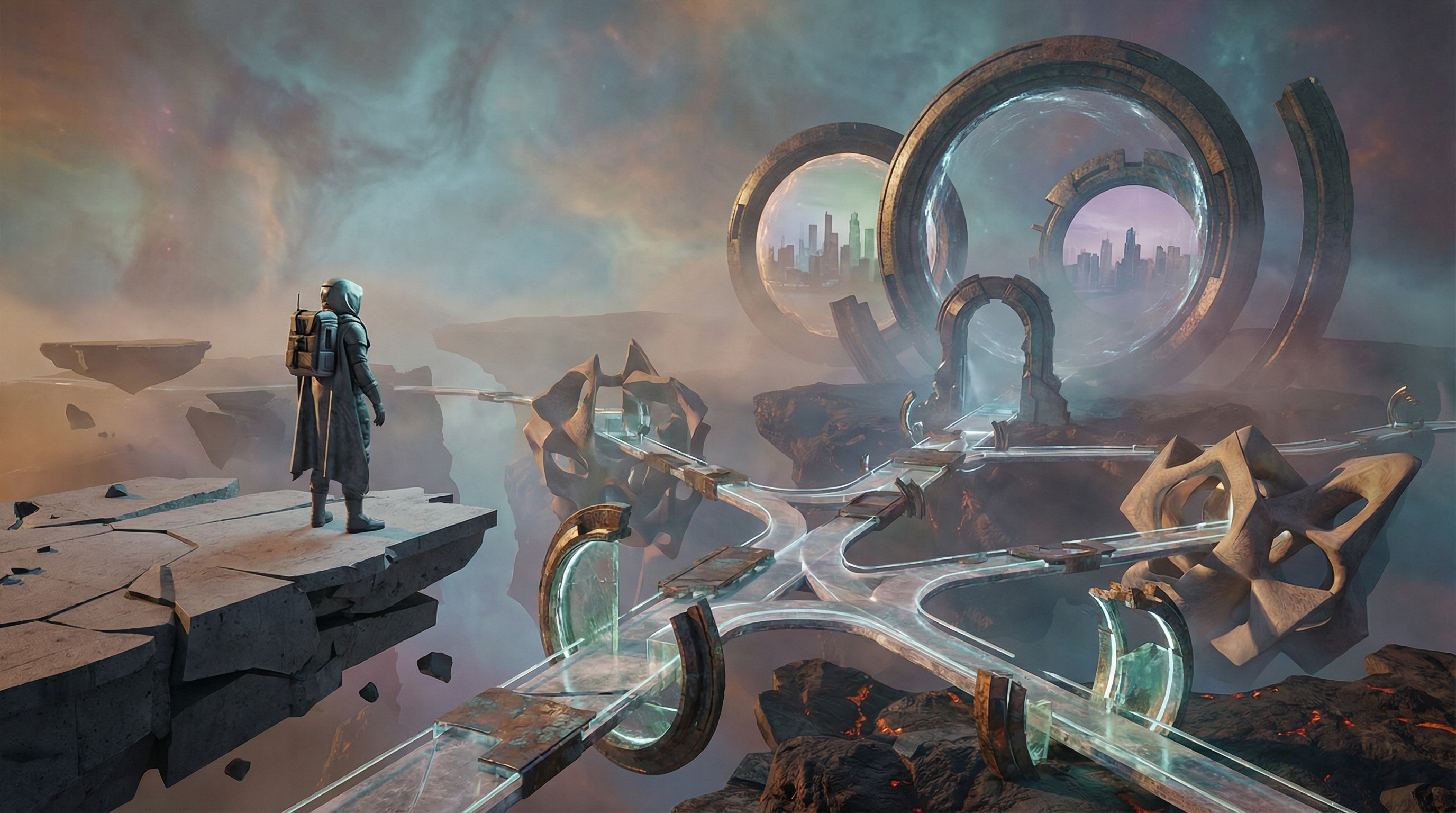
You know how when you're a kid, everything feels possible? Like, every choice is a portal to some alternate universe. You could be a skateboarder, or a scientist, or that person who makes YouTube videos about deep-sea fish. It's kinda wild thinking about all the parallel lives you could slip into. But then reality kicks in and society throws a bunch of expectations at you, pick a lane, they say. I'm not sure about you, but I find that pretty limiting. Life isn’t a straight highway; it’s more like one of those choose-your-own-adventure games. And the earlier you start flipping through the pages, the richer the story gets.
I mean, reality isn't this fixed structure we just wade through, like some well-lit path in the woods. It's more like a sprawling city built by a community of architects who couldn't decide on the final blueprint. Each street you walk down, every turn you take, those are the decisions that gradually shape what your personal reality turns out to be. And when you're young, everything's a bit experimental, right? You test, you taste, you see what vibes and what doesn’t. Here's the kicker though: what if by trying a thousand different things, you're not just building one life but all these parallel lives you could have had? Isn't that kinda comforting? You won't get to live all of them, but at least you’re sampling the possibilities.
Think about reality like this: each decision you make is a doorway to another "you,", another life you might inhabit for a day, a week, or ten years. The choices you don't make? They're that other you living in some cosmic elsewhere, maybe doing something amazing, or maybe not. But here's the thing: until you step through the door and see for yourself, you don't know. It's Schrödinger's career-path, and you're both the cat and the scientist. So the only way to unravel the mystery is by putting the hypothesis to the test, like actually doing the thing instead of just thinking about it.
The Illusion of Stability
Kind of feels like everyone wants you to get life sorted out early, right? Like, the classic "what do you want to be when you grow up?" line is thrown at you before you even know what life is. But here's something wild: stability, like in mainstream culture, is mostly an illusion. I mean, look around, careers, relationships, even entire industries can crumble overnight. Stability's just a comforting story we tell ourselves to keep on ticking through the chaos of life. So, the question becomes: why are we so scared of exploring different paths when instability's the only constant? If everything is already fluid, trying out different realities seems less risky, doesn't it?
It's funny, 'cause even adults who appear to have everything figured out, often don't. They're still exploring their own multiverse, perhaps in subtler ways. You wouldn't think your nerdy neighbor might be moonlighting as an indie game developer, right? Or that your high school English teacher is an aspiring novelist who just got tired of waiting tables. Stability and certainty might just be other words for complacency, in a way. It's like we pretend the box we're in is the only one that exists, but really, there are countless containers out there waiting for us to peek inside.
And yet, taking that leap to explore feels daunting. We're wired to crave safety, a survival mechanism that tells us to avoid the unknown. But what if embracing the unknown is the most profound form of security? By embracing uncertainty, we become more adaptable, more comfortable in a world that's ever-shifting beneath our feet. If we try those parallel paths, even briefly, we're building a toolkit of experiences, skills, and insights that way outmatch any static sense of security that staying in our comfort zone could give us.
Experiment as a Lifestyle
Imagine life as one massive lab experiment where you're the head scientist but also the lab rat. Yeah, sounds weird, but it's actually enlightening if you think about it. What I'm suggesting here is taking on a mindset where trying different realities isn't just for kicks, it's a lifestyle. You test, record, iterate. You know, like when your favorite app updates and you're curious about all the new features. You might find out that designing video games is a more thriving career than you thought, or that landscaping taps into your zen mode better than all those guided meditations you've downloaded.
This experimental mindset isn't about recklessly jumping into every fad or trend, though. It's about informed experimentation, doing stuff that interests you, maybe intimidates you a bit, but captivates you nonetheless. It's asking, "What if?" and then actually living out the answer. It's how you find your true preferences, not just the ones handed to you through a curriculum or parental guidance. Honestly, a lot of the time, what you're experimenting with will not pan out. But that's not the point. The point is that, now, you know. You're wiser and more experienced for it. You can now navigate your own life with actual data; your lived data.
You know what's cool? Our brains are built for this kind of experimentation. When we try new things, dopamine, the brain's pleasure chemical, kinda gives us a congratulatory thumbs-up. But it's more than that. Every new skill or experience creates new neural pathways, which makes the brain not only happier but sharper. That's not just a feel-good fact; it's science. Engaging in different pursuits keeps your mind agile and ready for whatever comes next, like a mental yoga workout that ensures you're limber enough to leap between realities if the situation demands.
Risks, Mistakes, and Lessons
So let's talk about failurePOST. Trying out multiple realities isn't all sunshine and memes. It's messy, uncomfortable, and sometimes downright humiliating. But, much like a workout, the pain is part of the process. When you fail, and trust me, failure is inevitable, you don’t just close a door; you open a window. It may sound like a cheesy line from a '90s romcom, but what I'm saying here is that every time you flub, you gain some kind of insight. You figure out what not to do next time, like real-world A/B testing.
One thing that sucks about failure is the shame it often brings. Society doesn't really reward mistakes, does it? We glorify successes, especially those shiny successes that appear effortless. But here's the truth: every admired figure has a closet full of failures. It’s just that our culture likes to whitewash the learning curve. So why beat yourself up for something that is fundamentally human? Think about mistakes as your textbook. In the end, the stumbles and falls are the teachers that push you to new evolutionary heights.
There's also this other side of risking it all, risking what people think. While many will admire your audacity, others will gossip behind your back, questioning why you can't "just pick something and stick with it." But people's perceptions are none of your business. Remember that your explorations belong to you and to the "you" who’s learning something universally invaluable along the way. No need to justify your choices to people who are themselves prisoners of convention.
The Power of Curiosity
It's curiosity that really fuels all this exploration. Curiosity is like this unquenchable thirst that gets you moving in directions you couldn't have planned; it breakdances in subway stations when everyone else is rushing by, earbuds in. It's the lifeblood of every innovator, artist, or anyone who's truly alive. Curiosity doesn't owe you a defined path, but it sure as hell shows you the paths you could take. Kind of like that one friend who's always getting into weird but strangely thrilling predicaments. And you know, sometimes, curiosity isn't about finding the answer but about asking a better question.
Albert EinsteinPOST once said, "I have no special talents. I am only passionately curious." Makes you wonder how undervalued curiosity is. We've boxed it into something only scientists or academics should possess. But really, curiosity is what makes life delicious. It colors the mundane, makes you see dimensions to life you’d have overlooked if you were just accepting things as they are. It’s curiosity that challenges our assumptions, nudges us to ask why something is the way it is, and if so, does it have to be that way?
And listen, you can cultivate curiosity. You can practice it by learning how to listen well, to read more, and to detach from judgment. Let curiosity lead you into conversations, into books you wouldn't normally pick up, or into life experiences that seem completely nonsensical from the outside. Everything is worth trying, and it's the questions we haven't thought to ask yet that will lead us to the opportunities we didn't know existed.
A Sidebar on Technology
Alright, let's talk tech for a sec. Imagine now, in an age where virtual realityPOST and augmented realityPOST are transforming the way we interact with the world, each potential life you could live is just another clickable option. We've got the tools to not just think about these parallel realities but actually step into them, even if only temporarily. In a way, technology is an ally in your quest for exploring all the different threads of life. You know, it's like it expands your trial-and-error sandbox from the physical world into other dimensions where you can leap across realities like the multiverse is just at your fingertips.
As technology evolves, it becomes less about how it works and more about how it empowers us to explore the worlds we weren.
Every video game you play, every VR experience, is like a mini-experiment in living another life. While it’s not a perfect avenue for self-discovery, it’s a start. Technology enables us to simulate scenarios that will realistically never happen, whether that's flying a spaceship or becoming a medieval knight. These experiences broaden our imaginations, blurring the boundaries between what's real and what's possible. It’s like the universe is opening up a flash drive of possibilities for you to scroll through at your leisure.
But here's the catch: while tech can enhance this quest for self-exploration, it can also distract. You could spend a whole lifetime in a digital fugue state, missing out on the actual exploration in the physical realm. It’s about balance, about leveraging tech as a tool in your exploration toolkit, not letting it become the entirety of your exploration itself. The digital and the physical should integrate, not compete, in this lifelong experiment.
The Importance of Community
Ever notice how exploration becomes ten times more interesting when it's shared? Sure, self-discovery is a personal quest, but it’s also a collective experience. Being part of a community, not just online but physically, where people's energies are in the room with you, turns exploration into a shared journey, a tapestry of interwoven realities that feed off each other. And it's like everyone else becomes a guide in your exploration. They bring in their own experiences, their own alternate lives that they’re living right alongside you, giving you insights you'd otherwise overlook.
Community's got your back when you're taking those leaps into unknown spaces. They've probably dabbled in things you haven't considered. They've hit roadblocks, made breakthroughs, and are willing to share their notes. You don’t need to face every risk alone. It's like a crowdsourced experiment, bees sharing where the best pollen hides. And sure, while autonomy is important, there's also something valuable in group accountability, like a kitchen where everyone's cooking up different realities but all adding something to the overall stew.
And then there’s the emotional texture, the deep-seated connection that makes the journey less lonely. Exploring new realities can be isolating at times, especially when you’re defying conventional norms. A supportive community serves as an anchor, as if the multiverse wasn’t just yours to explore but a shared space where everyone’s diving headfirst into different facets of existence. You get to explore not just your reality, but snapshots of others, broadening your perspectives tenfold.
Constantly Arriving
So where does this leave us? At the end of the day, we're all just here, figuring it out as we go along. Sure, not everything is perfect, but life is sorta like this never-ending hackathonPOST where you're constantly arriving but never quite finished. You're iterating, remixing, and reimagining your own version of life, making it richer and more fulfilling. It’s both messy and beautiful, and that's the point. Life isn't about making that one, final leap to some “ultimate” version of yourself but embracing the fact that you’re a living, breathing piece of art, still being painted. Staying fluid and open to life's myriad possibilities allows you to ride the changes like a pro.
And here's the kicker: there's no single right way to live. Each path you take is valid and offers value, even if it feels utterly random. That's the beauty of it. When you try stuff out, you’re making each moment another shot at life in the multiverse. You’re becoming fluent in the languages of various realities, and maybe that's the secret. Maybe it's about living so many lives in this one life that, years from now, you look back and say, "Wow, I've lived a thousand lifetimes."
Here's a thought: what if the exploration itself is the destination? That the act of trying, learning, experimenting, that's where life happens. So here's to a thousand tries, a million questions, and all the lives we have yet to live. And maybe, just maybe, all these parallel realities that we dabble in are just practice for the one we're really meant to live.
