STORIESDec 7, 2025
Quiet Conversations Over Loud Realities
Sometimes you find yourself in the middle of a conversation that feels like a forgotten cup of coffee, lukewarm and neglected. In those moments, truths emerge from the mundane, like tiny earthquakes under the surface.

Zac
Reality Designer
2min
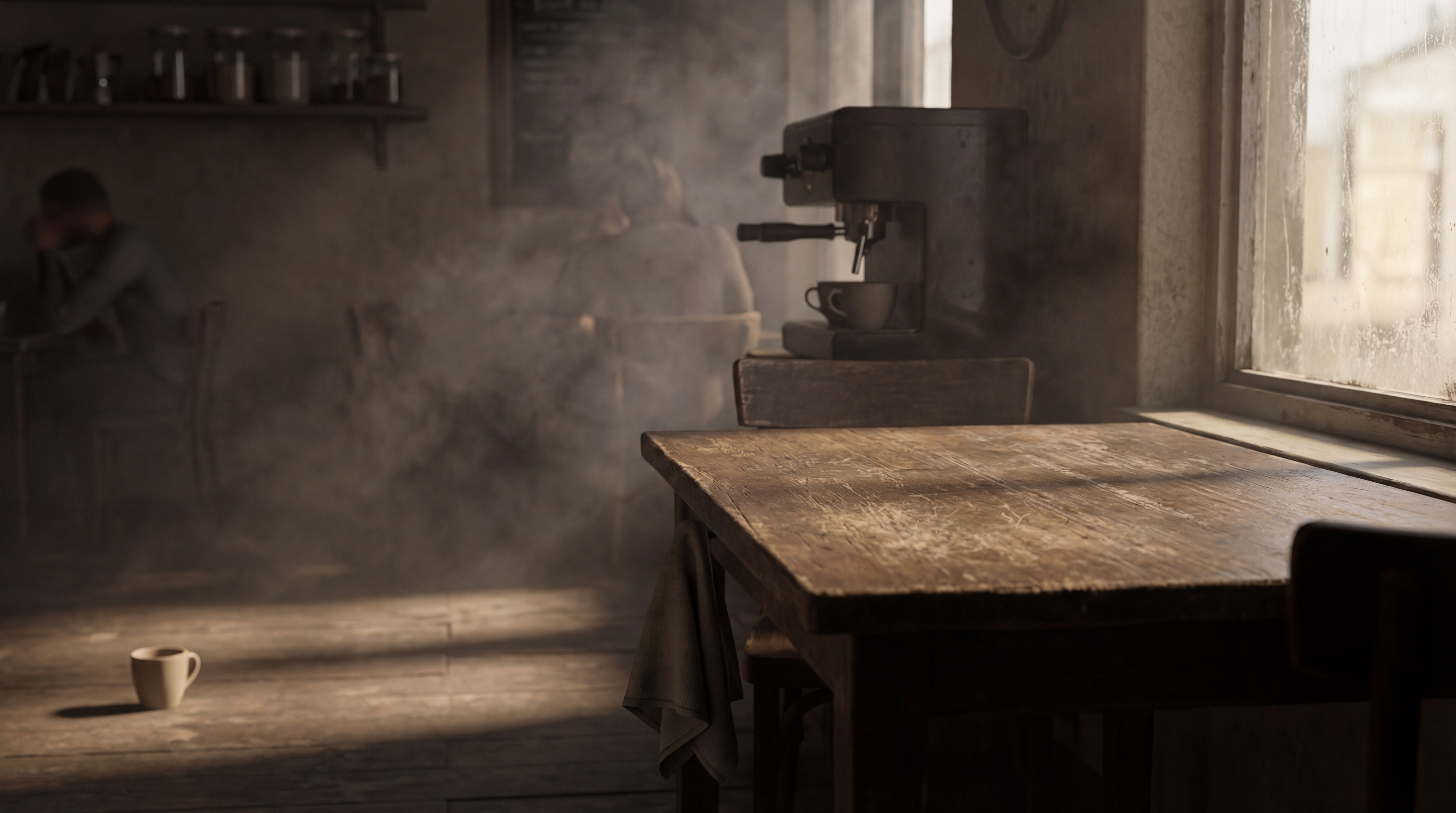
The café was small, tucked away between a dry cleaner and a nondescript office building. Inside, it smelled permanently of over-roasted beans, a scent so familiar it almost felt like home. The table was wobbly, one of its legs sitting unsteadily on a folded napkin, and I kept pressing my fingers against the rough wood, feeling the texture under my skin. It was a Tuesday afternoon, the kind that slips by unnoticed between the week’s more dramatic parentheses. I was halfway through a conversation with a friend, where words were exchanged more out of tradition than necessity, each statement met with polite nods and a sip from lukewarm mugs.
Sometimes, these quiet exchanges give rise to something unexpected. My friend, Sarah, was talking about her job, a topic she circled back to with the resigned diligence of a bee returning to a particularly uninteresting flower. The office politics, the endless meetings, none of it was revolutionary content. Yet, in one of those moments where the words seemed to drift away, she tilted her head and said, “You know, if you really think about it, everything feels kind of performed.”
Her statement hung there, a bit like dust in the afternoon light, visible yet intangible. I looked at her and noticed the way the dim lighting softened her features, turning her into a slightly more shadowy version of herself. Around us, the café continued its quiet orchestra of clattering cups and faint chatter. It was one of those sentences you could nod along to without risking any deeper conversation, but something in it hooked onto my thoughts. What do we perform, and what do we live?
If you really think about it, everything feels kind of performed.
In college, I once spent an afternoon with a group of theater students. They were rehearsing a play in a drafty auditorium, and I was only there because of a friend who needed a ride. The air smelled of dust and old curtains, and the mood was reverent, almost religious. As I watched them practice their lines, there was a moment of friction, a forgotten cue, a line delivered too flatly. The director halted the play, walking onto the stage with a deliberative slowness. He explained that the key to authenticity on stage was to believe the fiction. Not just act it, but truly embrace and live the narrative.
That idea has haunted me, following me into everyday moments like a shadow I can't shake off. How much of our lives is a kind of performance where we convince ourselves that the roles we play are true? Performances of competence at work, happiness on social media, or acceptance amongst friends. It’s both unsettling and freeing to imagine our daily narratives as mutable scripts, with an infinite number of alternative endings.

One of the most compelling examples of this comes from a time when I saw someone break free from a finely tuned script. It was at a wedding, which, for many, is a day of unparalleled performance. The event was a tableau of carefully curated moments, each one staged for posterity. The bride, Emma, was a study in grace, her smile fixed in timeless optimism. But as she walked past the rows of guests, I noticed a fleeting moment that solidified and then broke, her gaze caught my friend’s, and for a split second, her smile transformed from something polished to something raw.
Later, as the evening moved into the requisite speeches and good-natured toasts, Emma told a story that stood apart from the well-rehearsed narrative of romance and forever. She spoke about a time when she doubted everything, herself most of all. In the rawness of that story, there was an honesty that turned her from a bride into a person again. The room felt it, leaned into it, a collective surrender to something real and essential.
In the rawness of that story, there was an honesty that turned her from a bride into a person again.
On the drive back from that wedding, it struck me how rare it is to witness someone stepping out of their role like that. The way we navigate our realities often feels like a constant reheating of yesterday’s ambitions and assumptions. All too often, our conversations are recitations rather than revelations. Yet every now and then, someone lets the world in without a barrier, and the script dissolves into something unscripted and real.
topic. personal authenticity
Fast forward to the breakroom of a bland office building, the kind where the walls are always a shade of not-quite-white and the coffee is a faint approximation of caffeinated warmth. I was there during my stint at a summer internship that had promised to be enlightening but ended up feeling like a semi-permanent pause on my life plans. One of the regulars, an older guy named Jim, was a work irony in himself, stooped and grizzled, always nursing a cup of coffee that seemed eternally half-finished.
Jim would lean against the sleek kitchen counter, rambling on about anything from quantum physics to the futility of rush hour traffic, depending on his mood. Most days, his monologues provided a kind of white noise, background context to my own internal musings. But one afternoon, while musing about the future of AI, he said something unexpected. “You know, there’s gonna be a day when machines won’t just do our work. They’ll start learning to be ourselves better than we ever did.”
The remark could have been a throwaway line, some sidebar to a conversation, but it grabbed my focus with surprising force. I imagined a world where AI could learn our quirks and habits, compose emails in our voice, or make friends on our behalf. In that scenario, what’s left of us? The human fingerprints, the imperfections?

There’s gonna be a day when machines won’t just do our work.
We tend to forget our own uniqueness in a world that rewards conformity. It's easy to slip into a pre-existing mold since breaking away can feel like summoning a storm in a quiet harbor. But it's in these moments of divergence that our experiences crystallize into something more than a performance, more than a regurgitated echo of what came before.
Take social media, for instance, topic. social media authenticity a realm where performance often overshadows experience. Scrolling through the filtered lives of others, it’s easy to imagine a world of curated perfection. Yet, the stories behind those polished images speak louder than the pixels. A sunset isn’t just a captured moment, but perhaps the end of a particularly hard day or the beginning of an unanticipated adventure.
Then there's technology’s role in this. It's with us at every turn, shaping our reality with an almost frightening intimacy. Have you ever noticed how exhausted you feel after a day of constant digital interaction? There's an unwritten expectation that you should always be "on," always digitally present. Yet, beneath the onslaught of notifications and updates, there's a quieter reality, the slow erosion of solitude, the fading art of being alone with one's thoughts.
Possibly, it's the act of mindfulness that stitches together our experiences with threads of meaning. To notice the texture of an autumn leaf, or to listen with intent to a friend’s story without the buzz of digital interruption. It’s these moments that bear the light of authenticity, the small awakenings that allow us to perform less and live more.
The slow erosion of solitude, the fading art of being alone with one
In another café, on another mundane Tuesday, I watched a couple as they sat together, both engrossed in their phones. It struck me as odd, the silence that had settled between them, a familiar void in today’s digital symphony. At one point, the guy looked up, and for a second, there was a connection. a small smile exchanged, the shadow of something unscripted. But then, like clockwork, they returned to their screens, vanishing into their respective worlds.
I want to live in a world where more of us look up for longer, where experiences aren’t mediated through a tiny, glowing screen. It's about finding the courage to step away from our digital safety nets and into the unpredictability of real interactions. Those rare, genuine moments, like Emma's unscripted confession at the wedding or Jim's curious musings in the breakroom, are the things that pierce through our day-to-day performances.
I want to live in a world where more of us look up for longer.

Maybe what I'm trying to say, in this meandering reflection, is that every now and then, it’s worth challenging the scripts we've memorized. To pause, breathe, and ask whether we're truly living our lives or merely performing for an ever-watchful audience, whether human or machine. In those pauses, those remarkable interruptions, we might catch a glimpse of our own unique stories as they quietly unfold.
And maybe, if you sit still enough in that cafe or at a rehearsal, you could see how the world around you performs its intricate dance. No stage is too small for a revelation if you're willing to question the cues, open enough to let the curtain fall, and step into the rarity of unscripted moments.
End by trailing into a new thought.


